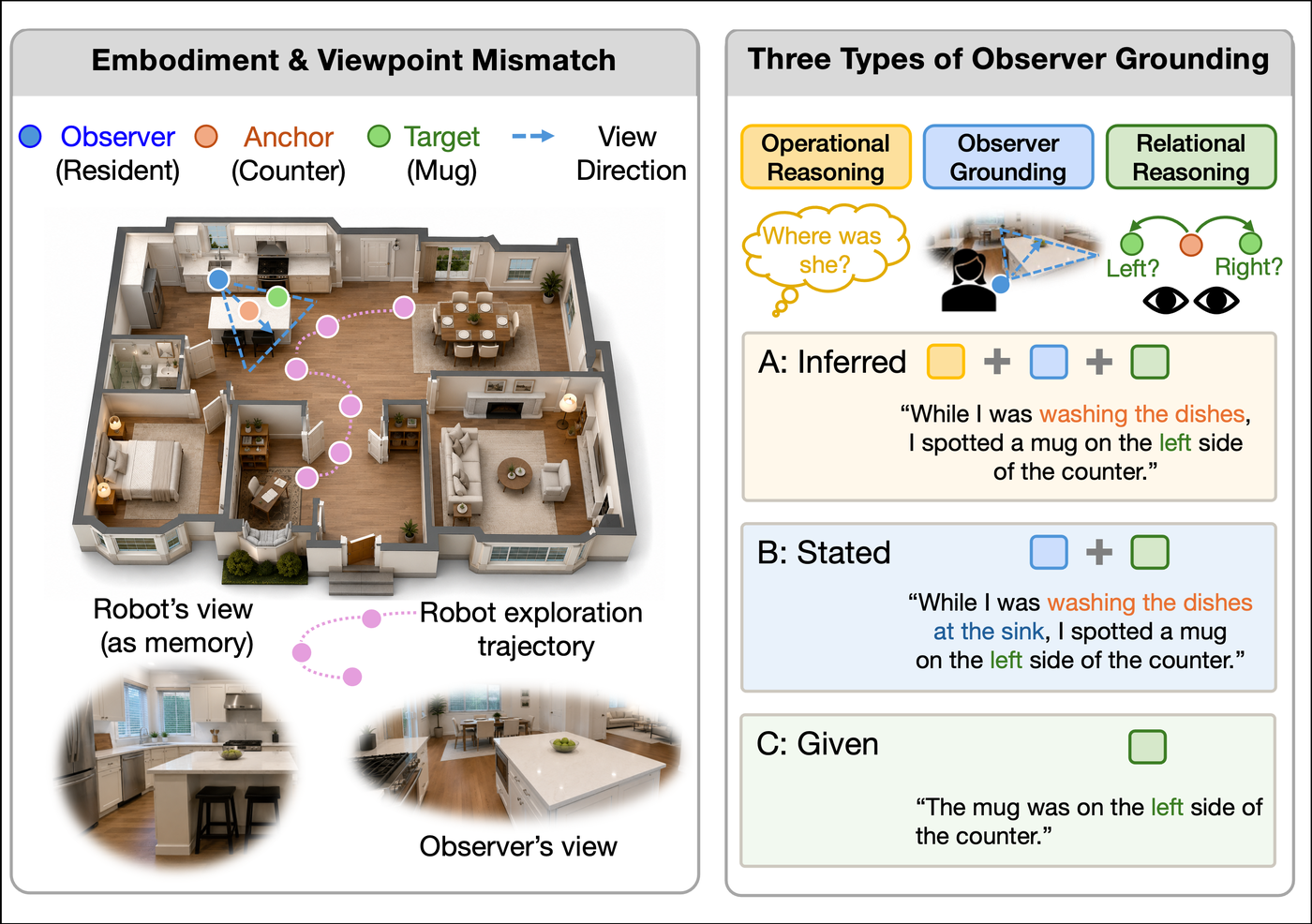
A robot explores a house and remembers it from its own viewpoint. The resident describes the mug from theirs. Resolving left means first working out where they stood and what they could see.
TL;DR We introduce POVBench, a benchmark for evaluating contextual observer grounding, and show that mapping observer-relative language to object locations remains a challenging problem for state-of-the-art VLMs.
A robot explores a house and remembers it from its own viewpoint. The resident describes the mug from theirs. Resolving left means first working out where they stood and what they could see.
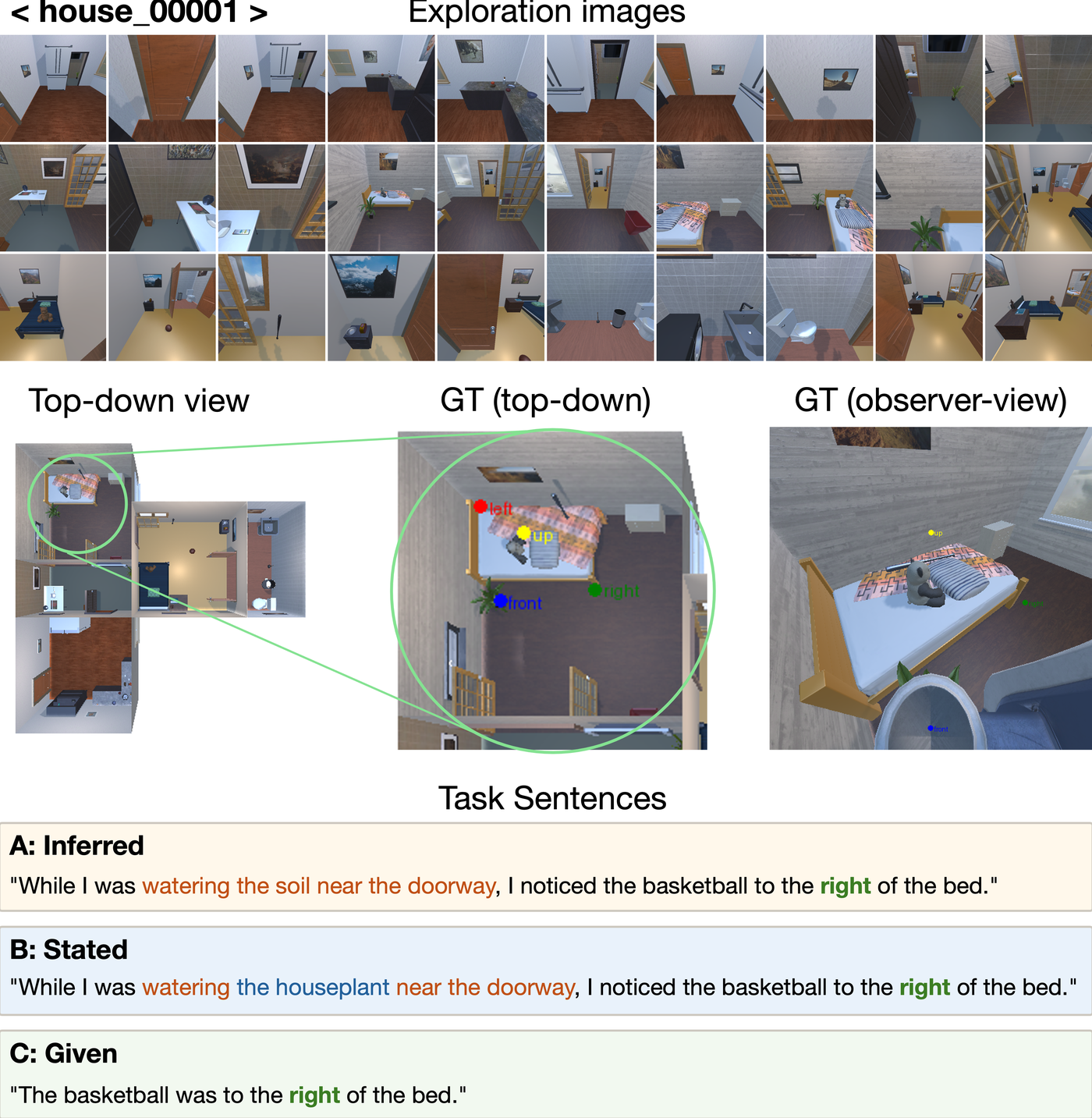
The three conditions share the same target placements but provide different levels of information about the observer's viewpoint, enabling direct comparison across conditions.
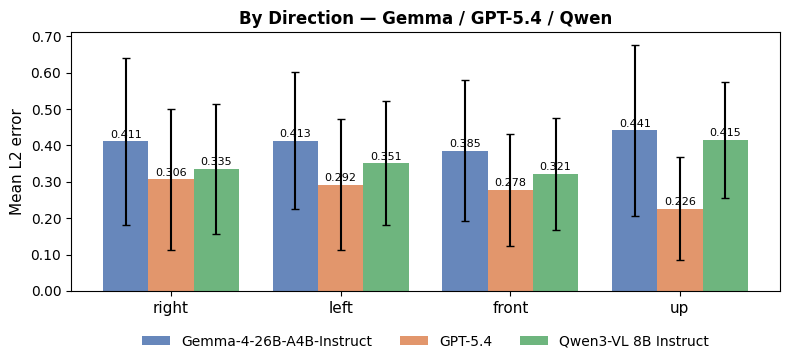
Contextual observer grounding remains challenging, with the best-performing model reaching a mean normalized L2 error of 0.294 under Inferred. Meanwhile, the Inferred–Stated gap is at most 0.012 across all evaluated models.
We evaluate ten VLMs spanning proprietary and open-weight general-purpose models as well as dedicated pointing models.
| Model | Inferred | Stated | Given |
|---|---|---|---|
| MolmoPoint-8B | 0.294 | 0.282 | 0.237 |
| GPT-5.4 | 0.315 | 0.311 | 0.189 |
| Qwen3-VL-8B (Transformer) | 0.372 | 0.369 | 0.296 |
| Qwen3-VL-8B (vLLM) | 0.359 | 0.356 | 0.291 |
| Qwen3-VL-32B (vLLM) | 0.449 | 0.440 | 0.488 |
| InternVL3-38B | 0.372 | 0.364 | 0.232 |
| Gemma-4 | 0.463 | 0.464 | 0.367 |
| Gemini-2.5-Flash | 0.489 | 0.487 | 0.434 |
| Gemini-Robotics-ER | 0.535 | 0.538 | 0.507 |
| RoboPoint | – | – | 0.209 |
| Llama-3.2-Vision | – | – | 0.433 |
Mean normalized L2 error, lower is better, averaged over three runs and spatial directions. Qwen3-VL-8B is tested with both Transformer and vLLM implementations. RoboPoint and Llama-3.2-Vision are evaluated only under Given, as they did not produce valid responses in the multi-image settings.
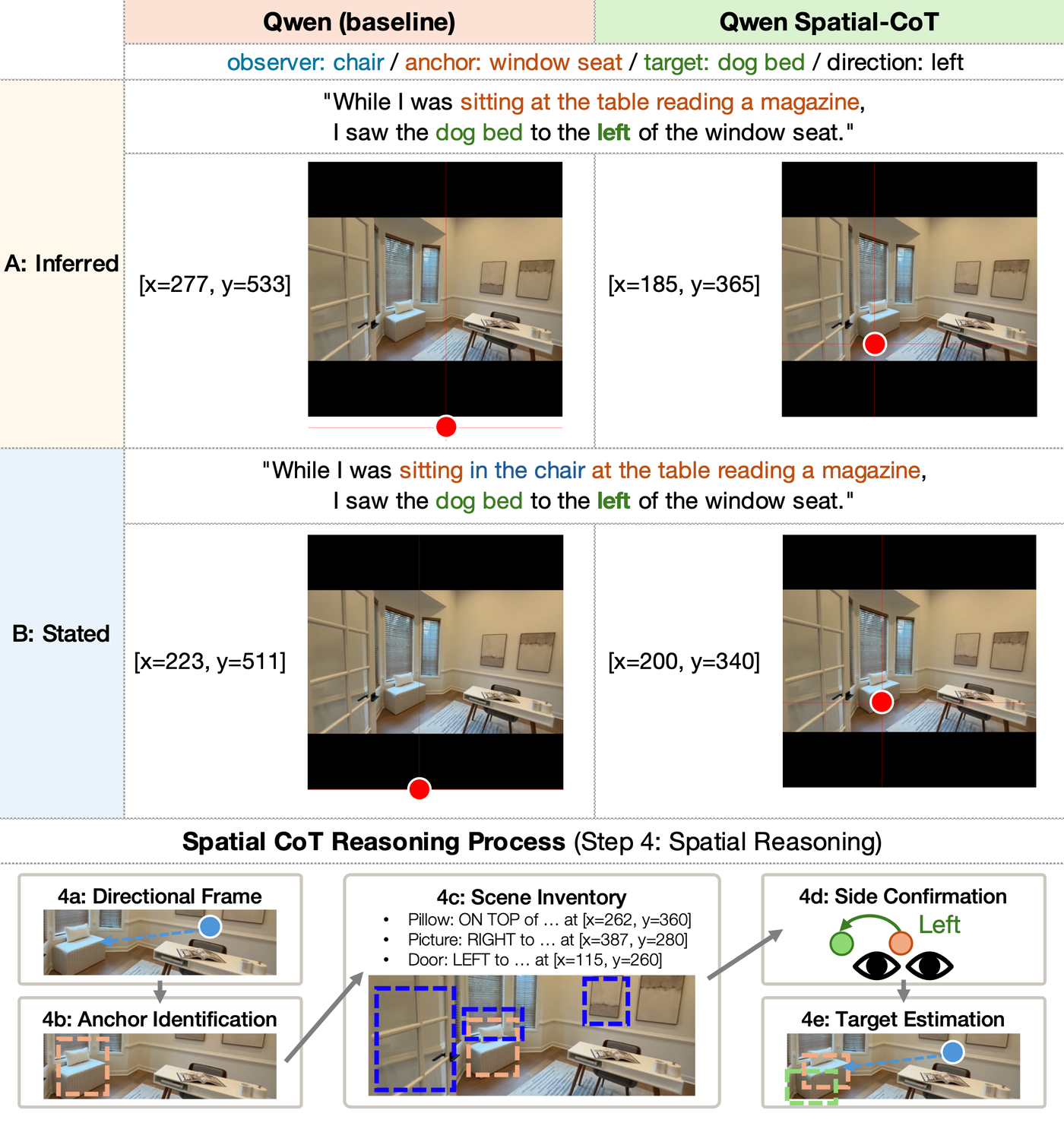
We test four interventions against the basic prompt on Qwen3-VL-8B: marking the observer, marking the anchor too, chain-of-thought, and Spatial-CoT.
| Intervention | Inferred | Stated | Resp. |
|---|---|---|---|
| Basic | 0.372 | 0.369 | 100% |
| O-Plot | 0.398 | 0.401 | 100% |
| O&A-Plot | 0.342 | 0.343 | 100% |
| CoT | 0.322 | 0.333 | 79% |
| Spatial-CoT | 0.294 | 0.302 | 85% |
Qwen3-VL-8B (Transformer), same protocol as above. Resp. is the response rate.
Spatial-CoT achieves the lowest L2 error under both Inferred and Stated, reducing error from 0.372 → 0.294 and 0.369 → 0.302, respectively.
We construct ten observer-centric scenarios with 102 instances from two house-tour videos and evaluate them manually.
| Model | Inferred | Stated | Given |
|---|---|---|---|
| GPT-5.4 | 0.29 | 0.21 | 0.41 |
| Qwen3-VL-8B (Transformer) | 0.03 | 0.09 | 0.24 |
| Gemma-4 | 0.41 | 0.38 | 0.47 |
| Gemini-2.5-Flash | 0.09 | 0.09 | 0.21 |
| Gemini-Robotics-ER | 0.29 | 0.24 | 0.24 |
| Qwen3-VL-8B + Spatial-CoT | 0.15 | 0.15 | – |
Manually evaluated success rates, higher is better, pooled over two house-tour videos.
Under the basic prompt no model exceeds 50% in any condition. Spatial-CoT also improves Inferred and Stated on Qwen3-VL-8B, suggesting that its benefit may extend beyond simulation.
Reasoning over language instructions in embodied tasks such as robotics often requires understanding spatial relations from a speaker's situated perspective. Humans infer such perspectives from shared environmental knowledge, activity context, and commonsense. Recent vision-language models (VLMs) appear capable of spatial reasoning, but their ability to infer a speaker's viewpoint from contextual cues and interpret situated spatial relations from that viewpoint remains unclear. We call this capability contextual observer grounding. To study this capability, we construct the Point-of-View Benchmark (POVBench), a dataset of 3D scenes and queries that disentangles Inferred, Stated, and Given forms of observer grounding in natural embodied communication. Given multi-view observations and a natural-language sentence, models must localize unseen or underspecified targets from situated spatial and contextual cues. Across state-of-the-art VLMs, localizing targets from directional language remains challenging, even when observer grounding is made explicit. We find that explicit breakdowns of observer-relative spatial reasoning improve target localization.
@inproceedings{shirasaka2026povbench,
  title     = {Contextual Observer Grounding: Evaluating Situated Spatial
               Reasoning in Vision-Language Models},
  author    = {Shirasaka, Mimo and Zhang, Haochen and Bisk, Yonatan},
  booktitle = {Findings of the Association for Computational Linguistics: EMNLP 2026},
  year      = {2026}
}